



Placental Abruption (Abruptio Placentae)
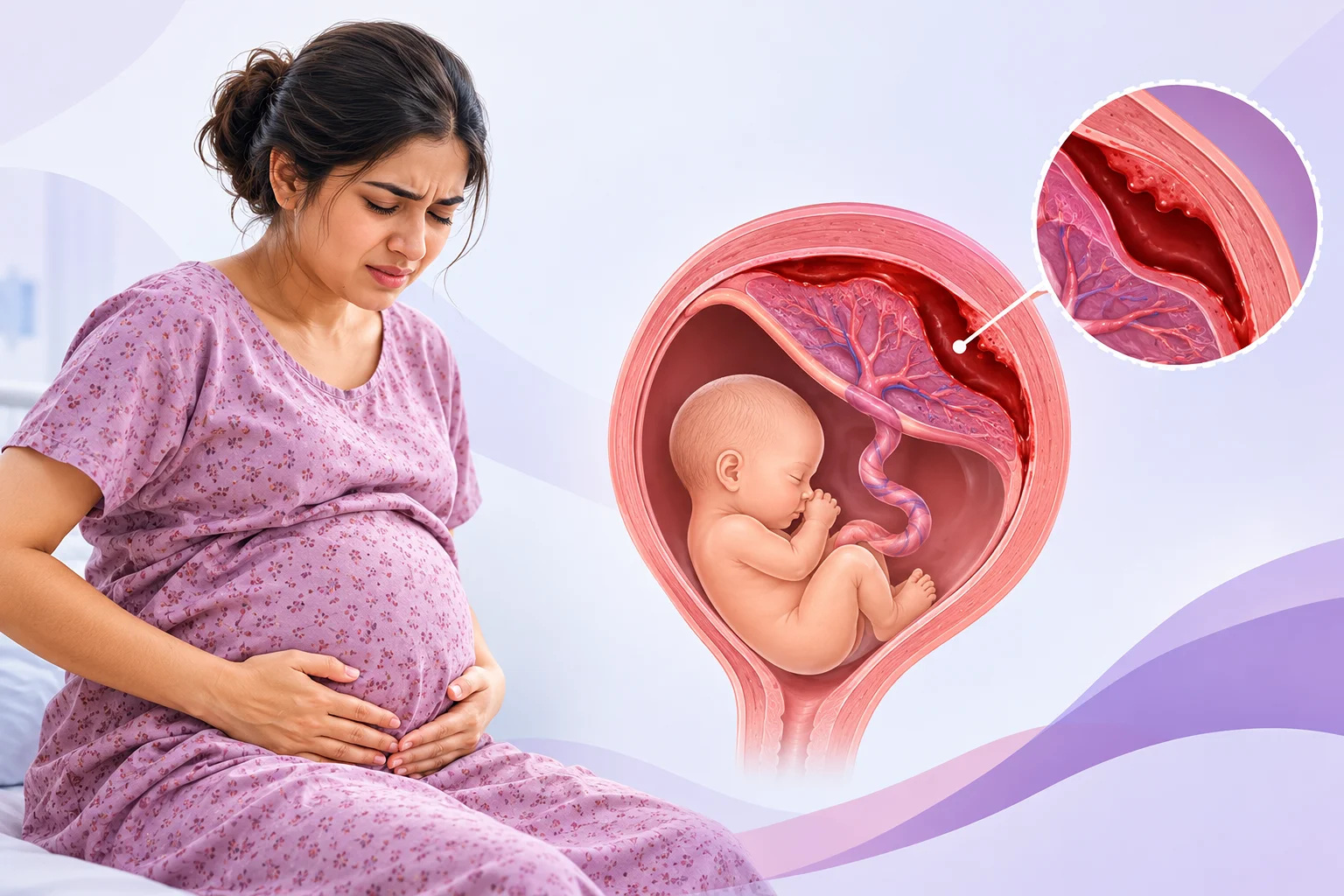
Placental abruption, also called abruptio placentae, happens when the placenta separates from the uterine wall before your baby is born. It can cause sudden abdominal pain, back pain or bleeding, although blood may stay hidden behind the placenta. Quick assessment is vital, and early care helps protect both you and your baby.

Seamless support from diagnosis to post treatment care
Overview
Pregnancy can bring unexpected changes, and some complications need medical attention sooner than others. If the placenta begins to separate from the uterus before the baby is born, it can affect the baby's oxygen supply and cause bleeding in the mother. This condition is called placental abruption. Although it can be serious, recognising the warning signs and receiving prompt medical care can make an important difference to the outcome for both mother and baby.
What is Placental Abruption?
Placental abruption, also called abruptio placentae, occurs when the placenta separates partly or completely from the uterine wall before birth. This can reduce the baby's oxygen and nutrient supply and cause maternal bleeding.
It usually occurs during the second half of pregnancy, particularly the third trimester, and affects approximately 0.5–1% of pregnancies. An Indian Ministry of Health and Family Welfare guideline cites an incidence of 1–2%.
Types of Placental Abruption
Based on bleeding, placental abruption is classified as:
- Revealed: Blood passes through the cervix, causing visible vaginal bleeding.
- Concealed: Blood collects behind the placenta, with little or no visible bleeding.
- Mixed: Some blood remains trapped while some passes through the cervix.
Grades of Placental Abruption
Based on severity, it is classified into three grades:
- Grade 1 (Mild): Minor bleeding without maternal or fetal distress.
- Grade 2 (Moderate): Uterine tenderness and contractions, with possible fetal distress.
- Grade 3 (Severe): Extensive bleeding, maternal shock, clotting problems and possible fetal death.
Prompt medical assessment is essential because visible bleeding may not reflect the severity of placental separation.
How Does Placental Abruption Affect The Mother and Baby?
The effects of placental abruption depend on how much of the placenta separates, how much bleeding occurs, and how far along the pregnancy is.
- For the baby: Separation of the placenta can reduce the oxygen and nutrients reaching the baby. A severe abruption may cause the baby to become distressed and may require early delivery.
- For the mother: The separation can cause bleeding, which may come out through the vagina or remain trapped behind the placenta. Heavy blood loss can affect blood pressure and, in severe cases, interfere with the body's ability to form blood clots.
Not every abruption leads to severe complications. However, because symptoms alone can make it difficult to judge severity, suspected placental abruption requires urgent medical assessment.
Causes of Placental Abruption
The exact cause of placental abruption is often unknown. It occurs when blood vessels connecting the placenta to the uterine wall are disrupted, causing the placenta to separate prematurely.
Possible triggers include:
- Abdominal trauma: A fall, road accident or direct blow to the abdomen can damage the placental attachment.
- Sudden uterine decompression: Rapid loss of a large amount of amniotic fluid, particularly with polyhydramnios (excess amniotic fluid), can cause sudden changes in uterine pressure and contribute to placental separation.
In many cases, no specific trigger can be identified. Placental abruption is not necessarily caused by anything the mother did or failed to do.
Risk Factors of Placental Abruption
Certain maternal health conditions, pregnancy complications and lifestyle factors are associated with a higher risk of placental abruption.
- High blood pressure and pre-eclampsia: Chronic hypertension, pregnancy-related high blood pressure and pre-eclampsia are among the strongest risk factors.
- Previous placental abruption: The risk of recurrence is approximately 10–15% after one previous abruption and 20–25% after two.
- Blood-clotting disorders: Certain inherited or acquired thrombophilias (conditions that increase blood clot formation) may increase the risk.
- Pregnancy complications: Multiple pregnancy, polyhydramnios, premature rupture of membranes (PPROM) and fetal growth restriction (FGR) are associated with increased risk.
- Maternal age and pregnancy history: Both younger maternal age (below 20 years) and older maternal age, having three or more previous births, and a previous caesarean delivery may increase risk.
- Uterine conditions: Fibroids (non-cancerous growths in the uterus) and certain uterine abnormalities may be associated with placental abruption.
- Smoking and substance use: Tobacco use, including smoking, and cocaine use increase the risk. Evidence for smokeless tobacco specifically is less established.
- Intimate partner violence: Physical abuse or abdominal trauma during pregnancy can cause placental separation.
- Assisted reproductive technology (ART): Pregnancies conceived through fertility treatments may have a higher risk, although the evidence is less consistent.
Having one or more risk factors does not mean you will develop placental abruption. The condition can also occur without any known risk factors. Early antenatal care, blood pressure management and avoiding tobacco and recreational drugs can help reduce preventable risks.
Symptoms of Placental Abruption
Placental abruption can develop suddenly, and symptoms vary from person to person. The main warning signs include:
- Vaginal bleeding: Bleeding may range from light to heavy, but it can also be absent when blood collects behind the placenta.
- Sudden abdominal pain: Pain may be persistent or come and go. The abdomen may feel tender when touched.
- Lower back pain: Some women experience new or persistent pain in the lower back.
- Frequent contractions: The uterus may tighten repeatedly, sometimes with little time between contractions.
- A firm or tender abdomen: The abdomen may feel unusually hard or painful.
- Reduced baby movements: You may notice that your baby is moving less than usual.
When to seek emergency care: If you experience sudden or persistent abdominal pain, vaginal bleeding, a painful or unusually firm abdomen, or reduced baby movements during pregnancy, seek urgent maternity assessment. Severe pain, heavy bleeding, faintness, or collapse requires emergency medical help. Do not wait for symptoms to settle, and do not assume that the absence of bleeding means everything is fine.
Concealed Placental Abruption: When There Is No Visible Bleeding
Sometimes, blood collects between the placenta and the uterine wall instead of flowing out through the vagina. This is known as a concealed placental abruption.
Because the blood remains inside the uterus, a person may have little or no visible bleeding despite a significant placental separation. Abdominal pain, tenderness, frequent contractions, or changes in the baby's movements may be the main warning signs.
Some cases develop more gradually and may be associated with repeated light bleeding or concerns about the baby's growth. Any suspected abruption needs assessment by an obstetric team, even if the bleeding is slight or absent.
Diagnosis of Placental Abruption
Placental abruption is diagnosed mainly through clinical assessment, including symptoms, physical examination and the baby's condition. An ultrasound may help identify placental separation, but it can miss an abruption. Therefore, a normal scan does not rule it out.
The medical team may recommend:
- Cardiotocography (CTG): Monitors the baby's heart rate and uterine contractions to identify signs of fetal distress.
- Complete blood count (CBC): Checks haemoglobin and platelet levels to assess blood loss and clotting-related concerns.
- Fibrinogen and coagulation profile: Assess blood-clotting function and identify complications such as disseminated intravascular coagulation (DIC).
- Kleihauer-Betke test: Helps detect fetal blood cells in the mother's circulation and assess fetomaternal haemorrhage.
- Blood group and Rh status: Helps arrange compatible blood for transfusion and determine whether anti-D immunoglobulin is needed.
Important: Concealed placental abruption can cause severe internal bleeding, DIC and fetal distress even when little or no vaginal bleeding is visible. Diagnosis and treatment should not be delayed while waiting for ultrasound confirmation.
Complications of Placental Abruption
Placental abruption does not always lead to serious complications, but the risks increase when a large part of the placenta separates or treatment is delayed.
For the Mother
- Heavy blood loss: Significant bleeding can cause a dangerous drop in blood pressure, known as shock.
- Blood-clotting problems: Severe abruption may affect the body's ability to form clots, making bleeding more difficult to control.
- Blood transfusion: A transfusion may be needed to replace blood lost during the complication.
- Surgery: In rare, severe cases, surgery to control bleeding may be necessary. Removal of the uterus (hysterectomy) may be required if bleeding cannot otherwise be controlled.
For the Baby
- Reduced oxygen supply: Placental separation can prevent the baby from receiving enough oxygen.
- Restricted growth: If placental function is affected over time, the baby may not grow as expected.
- Preterm birth: Early delivery may be necessary to protect the mother or baby.
- Stillbirth: A severe abruption can cause the loss of the baby, particularly when the separation is extensive and the oxygen supply is severely affected.
The risk of these outcomes depends on the severity of the abruption, the stage of pregnancy, and how quickly appropriate care is provided. Early assessment allows the medical team to identify complications and act when needed.
Treatment Options for Placental Abruption
Treatment depends on the extent of placental separation, the stage of pregnancy, the mother's condition and the baby's wellbeing. The priority is to stabilise the mother, manage bleeding and determine whether delivery is necessary.
- Emergency stabilisation: The medical team establishes two large-bore intravenous(IV) lines, checks blood counts and clotting, and arranges blood grouping and crossmatching. Severe bleeding may require a massive transfusion protocol involving red blood cells, fresh frozen plasma (FFP), platelets and fibrinogen replacement. Tranexamic acid may be used according to the haemorrhage protocol.
- Close monitoring: If the abruption is small and both mother and baby are stable, hospital observation may be recommended. This includes monitoring vital signs, bleeding, blood tests and the baby's heart rate.
Medicines before preterm delivery: If early delivery is anticipated, treatment may include:
- Corticosteroids: Before 34 weeks to support the baby's lung development.
- Magnesium sulphate: Before 32 weeks to help protect the baby's brain.
- Anti-D immunoglobulin: For eligible Rh-negative mothers to prevent Rh sensitisation.
- Delivery: Emergency caesarean birth is generally recommended when a live baby shows distress and needs urgent delivery. Vaginal birth is usually preferred when the baby has died and the mother is stable, provided there are no other obstetric complications.
- Managing complications: Oxytocin may be given after delivery to prevent postpartum haemorrhage (PPH). Severe bleeding may require blood transfusions, additional clotting factors or surgery. A condition called Couvelaire uterus, in which blood collects within the uterine muscle, may occur in severe cases. Hysterectomy (removal of the uterus) is rarely needed when bleeding cannot be controlled. Intensive care or high-dependency monitoring may also be necessary.
Placental abruption cannot be reversed with medication, and the separated portion of the placenta does not reattach. The obstetric team decides whether continued monitoring or delivery is safest based on the mother and baby's condition.
What Is the Prognosis (Outlook) for Placental Abruption?
The outlook after placental abruptiondepends on the extent of placental separation, blood loss, the baby's condition and the stage of pregnancy.
- Perinatal mortality: Placental abruption increases perinatal mortality at least 15-fold, from 8 per 1,000 singleton births without abruption to 120 per 1,000 affected births.
- Preterm birth: A large cohort reported preterm birth in 52.6% of pregnancies complicated by placental abruption, compared with 9.6% without it. Premature babies may need neonatal intensive care.
- Maternal complications: Severe bleeding can cause postpartum haemorrhage (PPH), disseminated intravascular coagulation (DIC) and the need for blood transfusions.
- Recurrence: The risk of placental abruption in a subsequent pregnancy was 3.35% in a 2024 US study, compared with 0.66% in women without a previous abruption.
- Long-term health: A history of placental abruption is associated with an approximately 1.8-fold higher risk of cardiovascular disease mortality later in life.
- Planning a Future Pregnancy:After recovery, discuss future pregnancy planning with your obstetrician. This may include early antenatal booking, blood pressure control, stopping tobacco use and additional fetal growth scans. The monitoring plan will depend on your medical history and previous pregnancy outcome.
With appropriate care and monitoring, many women go on to have successful pregnancies.
What Questions Should I Ask My Doctor?
Asking questions can help you understand your condition and take part in decisions about your care. Depending on your situation, you may wish to discuss the following.
Monitoring and Risk Questions
- What factors may have contributed to my placental abruption?
- What warning signs should prompt me to seek emergency care?
- How will you monitor my health and my baby's wellbeing?
- Will I need additional scans or antenatal appointments?
- Is there anything I can do to manage my individual risk factors?
Delivery and Future Pregnancy Questions
- Is it safer to continue the pregnancy or deliver the baby now?
- What would determine whether I need a caesarean birth?
- What care might my baby need after delivery?
- Does having a placental abruption increase my risk in a future pregnancy?
- What monitoring would you recommend if I become pregnant again?
If you are experiencing symptoms that could indicate an abruption, seek medical care first rather than delaying assessment to prepare questions. Your obstetric team can discuss these concerns once you are receiving appropriate care.
Prevention & Lifestyle Tips for Placental Abruption
Placental abruption cannot always be prevented, and it can occur even when you follow all recommended pregnancy advice. However, some steps can reduce certain risk factors and help you receive timely care.
- Avoid smoking and recreational drugs: Smoking and cocaine use are associated with a higher risk of placental abruption. Ask your healthcare team for support if you need help stopping.
- Manage high blood pressure: Attend appointments and take prescribed medicines as directed by your doctor.
- Use a seatbelt correctly: Place the lap belt low across your hips, below the bump, and the shoulder belt between your breasts and to the side of the bump.
- Get checked after abdominal trauma: Contact your maternity unit promptly after a road accident, fall or blow to the abdomen, even if you initially feel well.
- Attend antenatal appointments: Regular care helps your team identify and manage conditions such as high blood pressure.
- Follow individual medical advice: If you have had a previous abruption or have other risk factors, ask your obstetrician whether you need additional monitoring or a specific care plan.
These steps cannot eliminate the risk. The most important thing is to seek prompt assessment if warning signs develop and to follow the care plan recommended for your pregnancy.
Why Choose BirthRight by Rainbow Hospitals for Placental Abruption Care?
At BirthRight by Rainbow Hospitals, we understand that complications such as placental abruption can require urgent decisions and specialised maternity care. Our approach focuses on timely assessment, coordinated care, and clear communication to help mothers and their families understand the treatment needed at each stage.
- Specialist-led maternity care: Our obstetric teams assess the mother's condition, the baby's wellbeing and the severity of the placental abruption to guide timely treatment and delivery decisions.
- Coordinated care for high-risk pregnancies: When needed, care can involve obstetricians, anaesthesiologists, critical-care specialists and newborn-care teams, depending on the patient's condition and the services available at the hospital.
- Monitoring and emergency management: Our teams use appropriate maternal assessments and fetal monitoring to guide clinical decisions and respond to changes in the mother's or baby's condition.
- Delivery and newborn care: When early delivery is necessary, coordinated maternity and newborn-care planning helps address the needs of both mother and baby. The level of neonatal support available depends on the hospital location and the baby's condition.
- Support beyond the immediate emergency: We guide mothers through recovery, follow-up care, and discussions about future pregnancies, helping them understand the next steps in their care.
Choosing the right maternity team can make a difference when a pregnancy requires specialised attention. At BirthRight by Rainbow Hospitals, our focus is on providing individualised care, helping families make informed decisions and supporting mothers through the treatment and recovery process.
If you experience symptoms of placental abruption, seek emergency medical attention immediately. For pregnancy care and high-risk pregnancy consultations, contact your nearest BirthRight by Rainbow Hospitals centre to learn about the services available.
Disclaimer
This article is for general educational purposes only and does not replace individual medical advice, diagnosis, or treatment. Placental abruption can be a medical emergency. Seek immediate medical attention if you experience sudden or persistent abdominal pain, vaginal bleeding, reduced baby movements, or other concerning symptoms during pregnancy.

Find a Doctor and Book Appointment Online
Meet our specialist doctors who bring together clinical expertise, compassion, and personalised care to support your health and well-being. Choose from 1,300+ specialists across our network and book an appointment with BirthRight and Rainbow Children Hospitals, offering 24*7 support to you and your family.

Dr. Pranathi Reddy A
Clinical Director – Obstetrics & Gynecology.
English,Hindi,Telugu Banjara Hills

Dr. Gauri Vinayak Dhamangaonkar
Senior Consultant - Fetal Medicine
15 Years English,Hindi,Marathi,Telugu Kondapur OP, Banjara Hills

Dr. Shruthi Reddy Poddutoor
Consultant Obstetrician, Gynecologist & Laparoscopic Surgeon
English,Telugu Banjara Hills

Dr. Himabindu Veerla
Consultant Obstetrician, Gynecologist & Laparoscopic Surgeon
English,Telugu Banjara Hills

Dr. Bhargavi Reddy K
Consultant - Obstetrics and Gynecology
10 Years English,Hindi,Telugu Banjara Hills, Attapur Clinic

Dr. Annie Pranutha P
Consultant Obstetrics and Gynecology
9 Years English,Hindi,Telugu Banjara Hills, Attapur Clinic

Dr. Sasikala Kola
Consultant Obstetrician & Gynecologist
English,Hindi,Telugu Banjara Hills

Dr. Atigadda Vijaya
Consultant - Obstetrics & Gynecology
Hindi,Telugu Banjara Hills, Himayatnagar, Attapur Clinic

Dr. Nishanth Reddy Inavolu
Visiting Consultant Physician and Diabetologist & Internal Medicine
English,Hindi,Telugu Banjara Hills, Himayatnagar

Dr. Tulika Tayal
Consultant - Fetal Medicine
English,Telugu Banjara Hills

Dr. M Prathyusha Reddy
Consultant Obstetrics & Gynecology
English,Telugu Banjara Hills

Dr. Nithya Narasimha Murthy
Consultant -Psychiatrist
English,Hindi,Telugu Kondapur OP, Banjara Hills, Child Development Centre - Banjarahills Rd No 10

Dr. Brundavani
Consultant - Nutritionist
English,Hindi,Telugu Kondapur OP, Hydernagar, Banjara Hills, Child Development Centre - Banjarahills Rd No 10

Dr. Niveditha Chalmeda
Consultant
English,Telugu Banjara Hills

Dr. Kirti Reddy Patlolla
Consultant Obstetrics and Gynaecology
English,Telugu Banjara Hills, Attapur Clinic

Dr. Tuheena Sharma
Consultant - Perinatal Physiotherapy
10 Years English,Telugu Banjara Hills

Dr. Aditi Shah
Consultant - Fetal Medicine
English,Telugu Banjara Hills

Dr. Swathi Naga Tulasi Rayapureddy
Lactation Consultant
8 Years English,Telugu Banjara Hills

Dr. Swetha Reddy. S
CONSULTANT PERINATAL PSYCHIATRIST AND WOMEN MENTAL HEALTH SPECIALIST
13 Years English,Hindi,Telugu Banjara Hills

Dr. Addu Kiranmayi
Chief Clinical Nutritionist and Lifestyle Medicine Consultant
15 Years English,Hindi,Telugu Himayatnagar, Banjara Hills

Dr. Palle Nalini Kumari
Lactation Consultant
17+ Years English,Hindi,Telugu Banjara Hills
Dr. Nazia Tabassum
Consultant - Breast, Plastic & Reconstructive Surgeon
9 Years English,Hindi,Telugu,Urdu Banjara Hills

Dr. Sruthi Cheera
Consultant Breast Surgeon
5 Years English,Hindi,Kannada,Telugu Banjara Hills

Dr. Supriya Reddy
Lactation Consultant
5 Years English,Hindi,Telugu Banjara Hills

Dr. Niraj Krishnamurthy Yanamandra
Senior Consultant Obstetrician & Gynaecologist, Laparoscopy & Hysteroscopy Surgeon
English,Hindi,Telugu Hydernagar, Banjara Hills

Dr. B. Rao Bahadur
Consultant – Obstetrician & Gynecologist, Laparoscopic ,& Hysteroscopic Surgeon
22 Years English,Hindi,Konkani,Marathi,Telugu Banjara Hills, Kondapur OP

Dr. Sneha Kulkarni
Consultant - Child, Adolescent & Adult Psychiatrist
10 Years English,Hindi,Kannada,Telugu Secunderabad, Banjara Hills, Child Development Centre - Banjarahills Rd No 10

Dr. Lavanya Janagama
Consultant – Obstetrics & Gynecology
10+ Years English Banjara HillsLeading Hospitals for Women Care
Rainbow Children's Hospital stands as a testament to the hospital's continual pursuit of excellence and innovation, providing specialized care for women and children














chennai
Blogs
Discover our most recent health articles provided by our reliable experts.




What Are People Saying About Us
Embark on a journey of inspiration and hope with our patient success stories, complemented by informative videos from our dedicated doctors.


Media
 Common Gynaecological Surgeries to Fix Female Reproductive Issues
 Healthy Woman - Healthy World
 Healthier Women For a Healthier Future...
 Rainbow Children’s Hospital & BirthRight by Rainbow Launch Video Consultation Facilities
 Dr.Pranthi Reddy
 What is the use of that?
 Can you try this time?
 Pregnant Women are Not Unfit
 Declining Age of Menarche - A Matter of Concern
 Important Facts about Cervical Cancer
 Be careful before preempting
 Flu every month!
 Menstrual cramps
 Premature delivery
 Whether laughing or coughing...why?
 Multi - Tasking may be Cool but it's not Healthy
 Pregnant and Worried about COVID-19? Here's Everything you Need to know
 Video Consultation in Pandamic Situation for Pregnancy Women's
 Women.. Various types of cysts
 Recurrent Pregnancy Loss in Women
 Early Onset of Puberty: Causes, Symptoms and Treatment Options
Common Gynaecological Surgeries to Fix Female Reproductive Issues
Healthy Woman - Healthy World
Healthier Women For a Healthier Future...
FAQs
Can the baby survive placental abruption?
Can I have a vaginal birth after placental abruption?
How is placental abruption different from placenta previa?
Placental abruption occurs when the placenta separates from the uterine wall before birth. Placenta previa occurs when the placenta lies low in the uterus and covers or approaches the cervix. Both can cause vaginal bleeding, so bleeding during pregnancy should be assessed promptly rather than assumed to have a particular cause.
Is it safe to travel or exercise if I am at risk of placental abruption?
Can a mild placental abruption get better on its own?
Is bed rest recommended if I am diagnosed with placental abruption?
How soon after a car accident or fall should I get checked for placental abruption?
Can stress, anxiety or sex cause placental abruption?
Will my baby need NICU care if I have a placental abruption?
Does smoking or drug use increase the risk of placental abruption, and can quitting help?
Can placental abruption happen again in a future pregnancy?
Quick Links
Free Calculators to Track and Predict your Pregnancy
Understand your cycle and plan ahead with these quick, free fertility tools.
Gynecologist in Other Locations
Women's Health Conditions We Treat
- Mastitis (Breast Infection)
- PCOS (Polycystic Ovary Syndrome)
- Uterine Fibroids (Leiomyomas)
- Recurrent Pregnancy Loss
- Blocked Fallopian Tubes (Fallopian Tube Obstruction)
- Gestational Diabetes in Pregnancy
- Incompetent Cervix (Cervical Insufficiency)
- COVID-19 in Pregnancy
- Cytomegalovirus (CMV) in Pregnancy
- HELLP Syndrome
- Luteal Phase Defect
- Vasa Previa
- Listeria in Pregnancy
- Placenta Previa
- Endometrial Polyps (Uterine Polyps)
- Congenital Heart Disease in Pregnancy
- Hyperemesis Gravidarum (Severe Morning Sickness)
- Preeclampsia (toxemia)