


Embryo Freezing (Cryopreservation)
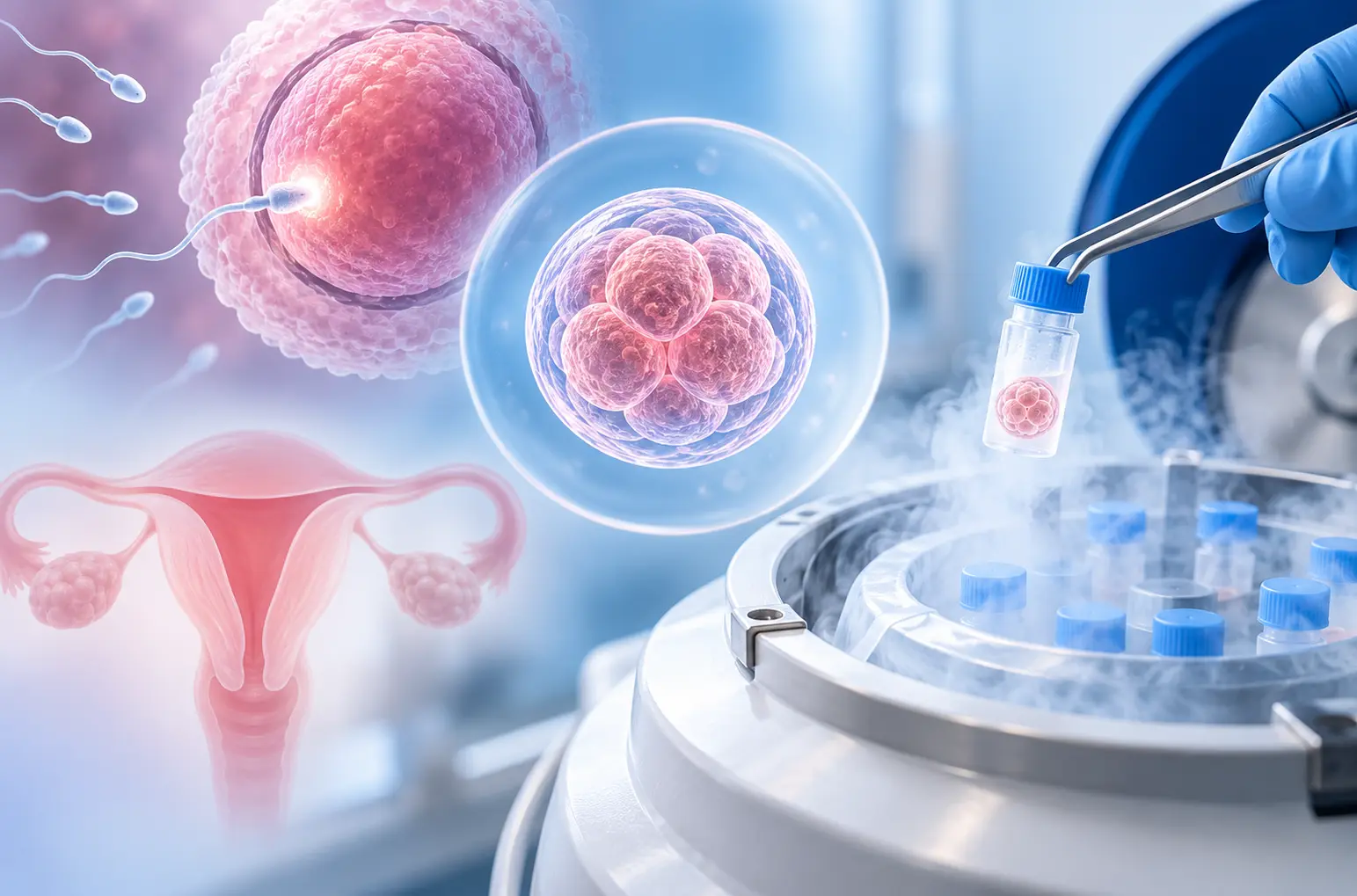
Embryo Freezing is the process of freezing and storing embryos created in an IVF cycle so they can be used in a future transfer. Also called embryo Cryopreservation, it helps couples who have surplus embryos, need time to recover between cycles, or are planning the next stage of fertility treatment.

Seamless support from diagnosis to post treatment care
Overview
Not every IVF journey follows the same timeline. Sometimes suitable embryos aren't transferred in the current cycle, or your doctor may recommend waiting before an embryo transfer. Embryo freezing, or cryopreservation, lets you store these embryos for possible use in a future cycle.
If embryo freezing has been suggested, you may be wondering how the process works, how long embryos can be stored and whether freezing affects their chances of success later. This page walks you through the process, benefits, success rates, safety, and cost, so you know what to expect as you plan your next steps.
What is Embryo Freezing (Embryo Cryopreservation)?
Embryo freezing, also called embryo cryopreservation, is the process of freezing and storing embryos at very low temperatures. Embryos are stored in liquid nitrogen at around -196 degrees Celsius. At this temperature, all biological activity pauses, so the embryo can be stored for years without aging.
Embryo freezing is closely related to egg freezing, though there is one key difference. Egg freezing stores unfertilised eggs. Embryo freezing stores embryos, which are eggs already fertilised with sperm that have started to develop. Because an embryo is a later, more informative stage, experts can often tell more about its quality before freezing. If you are still deciding between the two, read about egg freezing in detail.
Who Should Consider Embryo Freezing?
Embryo freezing helps in more situations than many people expect. It suits couples going through IVF, as well as those planning ahead for medical or personal reasons. The points below cover the most common reasons your doctor may suggest it.
- Surplus embryos from IVF: You have healthy embryos left after a fresh transfer, so freezing them lets you try again later without a full new cycle.
- A planned frozen transfer: Your doctor advises freezing so your body can recover from stimulation, or so your uterine lining is in the best possible condition.
- Before medical treatment: You are about to start treatment such as chemotherapy that could affect fertility, and want to preserve embryos beforehand.
- Planning for future siblings: You want the option of a genetically related brother or sister in the years ahead.
- Genetic testing of embryos: Testing usually requires freezing while the results come back.
If you are unsure whether embryo freezing is right for you, your specialist can guide you based on your age, diagnosis and plans.
Fertility Benefits of Embryo Freezing
Embryo freezing can provide greater flexibility during IVF and allow suitable embryos from one egg collection to be used in later transfer cycles. Its key benefits include:
- More transfer opportunities from one egg collection: Suitable embryos that are not transferred immediately can be stored for later use.
- Fewer repeat stimulation cycles: Using frozen embryos may allow another transfer without repeating ovarian stimulation and egg retrieval each time.
- Greater flexibility in transfer timing: The embryo transfer can take place in a later cycle when your doctor considers the timing appropriate.
- Time for the body to recover: When needed, freezing allows the transfer to take place after the ovarian stimulation cycle rather than immediately afterwards.
- Better use of suitable embryos: Embryos created during one IVF cycle can be stored instead of being limited to a single transfer attempt.
Together, these benefits give you flexibility and control over your family's timing. They also make each IVF cycle work harder for you. Your fertility team will help you decide how many embryos to freeze based on how your cycle goes.
Preparing for Embryo Freezing: Decisions You Will Make Together
Most preparation for embryo freezing is the same as for IVF, because the embryos come from an IVF cycle. What is specific to freezing is a set of decisions your clinic will ask you to think about in advance. Taking a little time over these now saves difficulty later.
1. Consent and ownership
Because an embryo is created from both egg and sperm, both partners usually give written consent for freezing, storage, and future use. Your clinic will explain what happens to the embryos in situations such as separation, or if one partner can no longer give consent. These are not comfortable things to consider, yet clear consent protects everyone involved.
2. How many embryos to freeze
Your embryologist will assess which embryos are strong enough to freeze. Not every embryo will be suitable, and that is normal. The number you store depends on how your cycle went, not a fixed target.
3. Storage duration and cost
Embryos can be stored for up to 10 years under the ART (Regulation) Act, 2021, with storage usually charged year by year. Ask about the annual cost and renewal process at the start. The cost section below gives approximate figures for India.
The Embryo Freezing Process, Step by Step
Embryo freezing is not a standalone treatment. Embryo cryopreservation is the final laboratory stage of an IVF cycle. The steps below show how it fits together, from stimulation to storage.
Step 1: Ovarian stimulation and egg collection
You take hormonal medication so your ovaries produce several eggs, usually over 10 to 14 days. The eggs are then collected in a short procedure under sedation.
Step 2: Fertilisation
In the laboratory, the eggs are combined with sperm, either by conventional IVF or by ICSI, so fertilisation can take place.
Step 3: Embryo growth
The fertilised eggs are cultured for a few days. Embryos may be frozen at day three (cleavage stage) or, more often now, grown to day five (the blastocyst stage), which helps identify the strongest embryos.
Step 4: Optional genetic testing
If you are having genetic testing of embryos, a few cells can be checked before freezing or after thawing, and the embryos are frozen while results come back.
Step 5: Vitrification, the actual freezing
Suitable embryos are frozen using a rapid method called vitrification. The embryo is cooled so quickly that water inside it turns glass-like instead of forming ice crystals, which could damage embryos with older slow-freezing methods.
Step 6: Labelling and storage
Each embryo is carefully labelled and stored in liquid nitrogen, where it waits, unchanged, until you are ready to use it.
The freezing itself happens in the laboratory, so you are not involved on the day it is done. Your active part is the IVF cycle that comes before it. Your embryologist will update you on how many embryos were suitable and frozen.
Side Effects, Risks and Safety of Embryo Freezing
Freezing itself is a laboratory process, so it carries no physical side effects for you. The side effects people experience are those of the IVF cycle that produces the embryos. For most patients, these are mild and settle quickly, and the list below covers what to expect.
- After stimulation and egg collection: Bloating, mild abdominal discomfort, tenderness at injection sites, and some spotting, usually easing within a few days.
- Ovarian hyperstimulation syndrome (OHSS): An uncommon but more serious reaction to fertility medication. Freezing all embryos and delaying transfer helps lower this risk. Contact your team if you have severe bloating, rapid weight gain, or breathlessness.
- Recovery timeline: Most women rest for a day after egg collection, return to light activity within a few days, and feel back to normal within about two weeks.
As for the embryos, vitrification is a well-established technique with high survival rates, covered in the next section. Large studies have not shown higher rates of birth defects in babies born from frozen embryos. Pregnancies from frozen transfers are linked to a slightly lower risk of preterm birth and low birth weight, but a slightly higher risk of high blood pressure in pregnancy and larger babies. Your doctor can explain how these risks apply to you.
Success Rates of Embryo Freezing
It helps to look at three separate numbers, because they answer three different questions. Will the embryo survive thawing, how likely is a frozen transfer to lead to pregnancy, and what will it cost? The figures below are broad ranges for guidance, and your numbers depend on your age when you created the embryos, embryo quality, and your health.
Frozen Embryo Transfer Success By Age
Success is far more closely linked to your age when you froze the embryos than to how long they have been stored. A frozen embryo is essentially preserved at the age it was created. So embryos frozen at a younger age tend to carry that advantage forward.
| Age when embryos were frozen | Approximate live birth rate per frozen transfer |
|---|---|
| Under 35 | Around 40 to 60 percent |
| 35 to 37 | Around 35 to 45 percent |
| 38 to 40 | Around 25 to 35 percent |
| Over 40 | Lower, and best discussed individually |
Frozen embryo transfers today give pregnancy rates comparable to fresh transfers, and sometimes slightly better, because timing can be optimised. Your clinic can give you a personalized estimate based on your own embryos.
Survival Rate of Embryo
Thaw survival is the chance that an embryo survives the warming process intact and is ready to transfer. Modern freezing has made the biggest difference here, as the comparison below shows.
| Freezing method | Approximate embryo survival after thawing |
|---|---|
| Vitrification (current method) | Around 90 to 95 percent or higher |
| Slow freezing (older method) | Around 60 percent |
In practice, this means most embryos frozen today survive thawing well. It is one reason frozen transfers have become so routine. Your embryologist checks each embryo after thawing before transferring it.
Embryo Freezing Cost in India
Costs vary between cities and clinics, and the freezing fee is usually separate from the IVF cycle and the later transfer. It roughly costs around ₹1.5 Lakh to ₹3 Lakh. The figures below are estimated ranges to help you plan, and your clinic can give you an itemised estimate.
| Item | Approximate cost in India |
|---|---|
| Embryo freezing (vitrification) | Around ₹20,000 to ₹50,000 |
| Annual storage | Around ₹20,000 to ₹50,000 per year |
| Frozen embryo transfer (FET) cycle | Around ₹40,000 to ₹1,00,000 |
These figures cover freezing, storage and transfer. The IVF cycle that creates the embryos is a separate, larger cost. When you compare clinics, ask what each quote includes, particularly whether medication and monitoring are counted separately, so the comparison is fair.
Frozen Embryo Transfer: What the Procedure Involves
When you are ready to use your frozen embryos, the frozen embryo transfer procedure is straightforward and largely gentle. It does not repeat the egg collection stage, which many patients are relieved to hear. The steps below walk through a typical cycle.
1. Preparing the uterus
Over a couple of weeks, your uterine lining is prepared, either following your natural cycle or with hormonal support, so it is ready to receive an embryo.
2. Thawing the embryo
On the day of transfer, the embryologist warms the chosen embryo and checks that it has survived and is developing as expected.
3. The transfer
The embryo is placed into your uterus through a thin, soft catheter passed through the cervix. It takes only a few minutes, usually needs no anaesthesia, and feels similar to a smear test for most people.
4. The two-week wait
After about two weeks, a blood test confirms whether the transfer has led to a pregnancy.
The two-week wait is often the hardest part emotionally, and that is completely understandable. Your team can tell you what to do and what to avoid during it, and are there for your questions. Support is a normal part of fertility care, not an extra.
How Long Can Embryos Be Stored, and What Happens to Unused Ones?
These are among the most common and most personal questions patients ask, so it is worth being clear about both. The first is about time, and the second is about choice.
In India, the Assisted Reproductive Technology (Regulation) Act, 2021 governs embryo storage. Under the Act, a commissioning couple may store embryos for up to ten years. Importantly, storage time does not reduce an embryo's quality. An embryo frozen for several years and thawed carefully performs much like one frozen recently. Time in storage is not the same as aging.
At the end of the permitted period, or once your family is complete, you decide what happens to any embryos you have not used. Depending on the law and your original consent, the options generally include allowing them to perish or donating them for research. There is no rush to decide this on day one. Your clinic and counsellor will support you through the choice, whatever you decide.
Why Choose BirthRight Fertility by Rainbow Hospitals for Embryo Freezing?
Freezing embryos means trusting a team with something precious, so it is fair to ask what stands behind that trust. BirthRight Fertility by Rainbow Hospitals brings clinical and laboratory expertise together in one place. The points below show what that means for you.
- Experienced embryology and clinical teams: Working side by side, so your care is coordinated from IVF through freezing to transfer.
- Modern vitrification and monitored storage: So your embryos are frozen and kept using current, well-validated methods.
- Clear counselling on consent and storage: So you understand every decision before you make it.
- Emotional support through every stage: Because fertility care is about the person, not only the procedure.
BirthRight Fertility by Rainbow Hospitals brings three decades of expertise in fertility, with thousands of successful gynaecological surgeries and more than 100,000 parenthood journeys supported across 15 Level II fertility centres in India. When you are ready to talk it through, our fertility specialists can review your situation. They will help you decide whether embryo freezing is the right next step for you.
Disclaimer
This content is for general educational purposes and does not replace professional medical advice. Success rates, costs and storage rules are indicative and can change. Consult a qualified fertility specialist for guidance based on your individual circumstances.

Find a Doctor
Expertise you can trust, Meet our esteemed doctors who bring exceptional knowledge, compassion, and innovation to provide top-notch care for your health and well-being.

Dr. Ratna Durvasula
Consultant Fertility Specialist
English,Telugu Kondapur OP, Banjara Hills, Financial District, Kondapur IP

Dr. Sudharani Bairraju
Senior Consultant Obstetrician and Gynaecologist, Laparoscopic surgeon and Infertility (IVF) Specialist
English,Telugu Banjara Hills

Dr. Lakshmi Chirumamilla
Fertility Specialist and Reproductive Endocrinologist
25 Years English,Hindi,Telugu Banjara HillsLeading Hospitals for Fertility Care
Rainbow Children's Hospital stands as a testament to the hospital's continual pursuit of excellence and innovation, providing specialized care for women and children



















chennai
Blogs
Discover our most recent health articles provided by our reliable experts.




What Are People Saying About Us
Embark on a journey of inspiration and hope with our patient success stories, complemented by informative videos from our dedicated doctors.



Media
 Dr. Preethi Reddy Article on Lifestyle Changes to Improve Fertility | BirthRight Fertility by Rainbow
 Dr. Ratna Duravasula Sr. Infertility Specialist
 Surrogacy, a Boon when Normal
 Surrogacy, a Boon when Normal Pregnancy is Medically Inadvisable
 Fertility... Modern Treatments
 A month after covid subsided....
 Can the baby's heartbeat be heard in an ectopic pregnancy?
 Doctors Exploit Loopholes in Bill
 Fertility counseling
 JCI Accreditation
 Menstrual cramps
 So Why are Men Turning into Women?
 Hysteroscopy- Procedure Of Choice For Intrauterine Problems
 Diet and Exercise in Pregnancy- Bust your Myths and Know your Facts
 Recurrent Pregnancy Loss
 Do Laptops, Excessive Heat and Tight Jeans Cause Infertility?
 In Vitro Fertilization
 Menstrual cup – are we really aware of it?
 No More Worries About Menopause
 Stretch marks in pregnancy: Embracing the scars
 Egg Freezing
 Fertility Preservation: Methods and Indications for Securing Reproductive Options
 Tips for planning a pregnancy
 Inferticity
 Here is all what you need to know about IVF, the popularly known fertility treatment
 Delayed marriage among factors for birth rate dip
 Fertility against Odds: IVF hope for women above 40 years of age
 Will Pregnancy Cure Endometriosis?
 Postpartum Depression: Expert Lists Essential Foods Prevent Depression in New Mothers
 Complications of Gestational Diabetes During Pregnancy by Dr. Triveni Arun Akkiraju
 Five Key Sexual Health Facts for Women
 Six Reasons That May Cause IVF Failure
 దంపతుల్లో ఈ మూడు లోపాలుంటే పిల్లలు పుట్టరు
 IVF and Genetic Testion - Essential Insights
 In vitro fertilization (IVF)
 About In Vitro Fertilization
 What is the IVF cost?
 What is the cost of IVF?
 Tick-Tock on Biological clock: Fertility concerns multiply in Telugu States
 Diminished Ovarian Reserve (DOR): Causes, Diagnosis, and Treatment Options by Dr. Shreeja Karan
 25 Years of Anniversary - Rainbow Children's Hospital & BirthRight
 Rising infertility: Addressing Challenges with Laparoscopy & Hysteroscopy
Dr. Preethi Reddy Article on Lifestyle Changes to Improve Fertility | BirthRight Fertility by Rainbow
Dr. Ratna Duravasula Sr. Infertility Specialist
Surrogacy, a Boon when Normal
FAQs
Can I freeze all my embryos and do a frozen transfer later?
What is the difference between a fresh and a frozen embryo transfer?
How do I know if my embryos are good quality?
How long can embryos be frozen?
What happens to frozen embryos if I do not use them?
What is the success rate of a frozen embryo transfer?
When can I do a frozen transfer after a failed fresh transfer?
How much does embryo freezing and storage cost in India?
Do babies born from frozen embryos have any differences?
What is blastocyst freezing, and is it better than day three?
Do frozen embryos survive the thaw process?
Is a frozen embryo transfer as successful as a fresh one?
Quick Links
Free Calculators to Track and Predict your Pregnancy
Explore Our Fertility Specialist Near You
- Fertility Specialist in Hyderabad
- Fertility Specialist in Bangalore
- Fertility Specialist in Chennai
- Fertility Specialist in Delhi (NCR)
- Fertility Specialist in Vijayawada
- Fertility Specialist in Vishakhapatnam
- Fertility Specialist in Guwahati
- Fertility Specialist in Rajahmundry
- Fertility Specialist in Guntur