


Ectopic Pregnancy (Extrauterine Pregnancy)
An ectopic pregnancy, also known as an extrauterine pregnancy, occurs when a fertilised egg implants outside the uterus, usually in a fallopian tube. It cannot develop safely and requires prompt medical attention. Understanding its symptoms, causes, treatment options and recovery can help protect your health and future fertility.

Seamless support from diagnosis to post treatment care
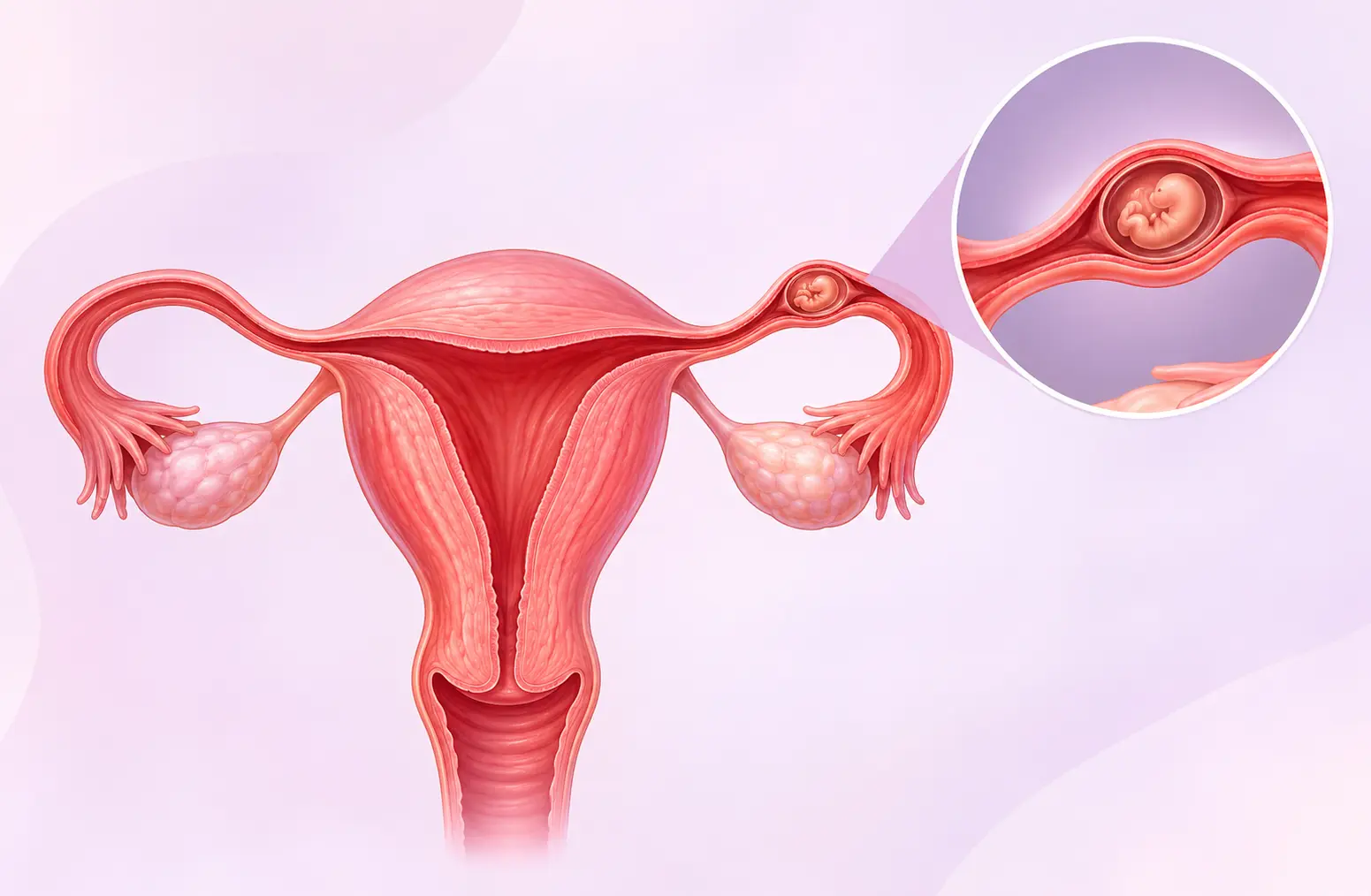
Overview
An ectopic pregnancy happens when a fertilised egg implants outside the uterus, most commonly in a fallopian tube. Because the pregnancy cannot continue normally in this location, early diagnosis and treatment are important to reduce the risk of complications.
Understanding the possible symptoms can help you know when to seek medical care. This page explains what causes an ectopic pregnancy, the early warning signs and the treatment options available, along with what recovery may involve.
Seek urgent medical care if you develop sudden severe abdominal pain, shoulder-tip pain, heavy bleeding, dizziness or fainting, particularly if you are or could be pregnant.
What is an Ectopic Pregnancy?
An ectopic pregnancy happens when a fertilised egg implants outside the uterus instead of inside it, where a pregnancy normally grows. In most cases, it develops in one of the fallopian tubes, which is why it is also called a tubal pregnancy.
Unfortunately, a pregnancy cannot continue normally outside the uterus, and it cannot be moved into the uterus. As it grows, it may stretch or damage the fallopian tube and, in some cases, cause internal bleeding. This is why early diagnosis and treatment are important for protecting your health.
Ectopic pregnancy affects around 1 to 2 per cent of pregnancies. Although it can be difficult to experience, timely treatment can help manage the condition safely and reduce the risk of serious complications.
Normal Pregnancy Implantation vs Ectopic Pregnancy
Understand how a normal pregnancy differs from an ectopic pregnancy, including where implantation occurs and why early diagnosis is important.
| Normal Pregnancy | Ectopic Pregnancy |
|---|---|
| In a healthy pregnancy, an egg is fertilised in the fallopian tube and then travels down into the uterus over several days. | In an ectopic pregnancy, the fertilised egg does not reach the uterus, often because the tube is damaged or blocked, so it implants where it is, usually in the tube itself. |
| There, it implants in the uterine lining, which is built to stretch and nourish a growing baby. | The tube cannot expand safely or support the pregnancy the way the uterus can. |
| As the pregnancy grows, it can stretch and eventually rupture the tube, which is the danger that makes early diagnosis so important. |
Causes of Ectopic Pregnancy
Most ectopic pregnancies happen because something slows or blocks the fertilised egg on its journey down the fallopian tube. The reasons for ectopic pregnancy usually involve damage to the tube, though sometimes no cause is found. The main ectopic pregnancy causes are below.
1. Previous pelvic inflammatory disease (PID)
Pelvic inflammatory disease, often from sexually transmitted infections such as chlamydia, can scar and narrow the fallopian tubes. This scarring makes it harder for the egg to pass through, so it may implant in the tube. In India, genital tuberculosis is another infection that can damage the tubes in the same way.
2. Damage or surgery to the fallopian tubes
Previous surgery on the tubes, including sterilisation or an operation for a past ectopic pregnancy, can leave scarring that raises the risk. Damage from conditions such as endometriosis can also affect how the tube works. A tube that has been injured before is more likely to trap a pregnancy.
3. A previous ectopic pregnancy
If you have had an ectopic pregnancy before, your risk of another is higher, at around 1 in 10. This is often because whatever affected the tube the first time may still be present. Your doctor will watch an early pregnancy closely if you have this history.
4. Assisted conception and other factors
Fertility treatment such as IVF slightly raises the risk, as can become pregnant with an intrauterine device (IUD) in place. Smoking and older age are also linked to a higher risk. Even so, up to half of women who have an ectopic pregnancy have none of these risk factors.
These causes often trace back to fallopian tube health, which is why tubal conditions matter. If you have risk factors, an early scan in a new pregnancy is a good idea. Our blocked fallopian tubes and hydrosalpinx pages explain related tubal problems.
Risk Factors for Ectopic Pregnancy
Some women carry a higher chance of an ectopic pregnancy, usually because of a history that affects the fallopian tubes. Knowing your ectopic pregnancy risk factors helps you and your doctor stay alert in early pregnancy. The main ones are below.
- A previous ectopic pregnancy: One of the strongest risk factors, raising the chance of another to around 1 in 10.
- A history of pelvic infection or STIs: Including chlamydia and, in India, genital tuberculosis, which can scar the tubes.
- Previous tubal or pelvic surgery: Including surgery for a previous ectopic pregnancy. If pregnancy occurs after sterilisation or while a tubal ligation is in place, the risk of ectopic pregnancy is high.
- Endometriosis: Which can affect the tubes over time.
- Fertility treatment or an IUD in place: IVF slightly raises the risk, as does conceiving with an IUD fitted.
- Smoking and older age: Both are linked to a modestly higher risk.
Having a risk factor does not mean you will have an ectopic pregnancy, and up to half of women who do have none of these. Still, if any apply to you, tell your doctor when you become pregnant. An early scan can confirm the pregnancy is in the right place.
Sign & Symptoms of Ectopic Pregnancy
The signs and symptoms of ectopic pregnancy often begin like a normal early pregnancy, which is why they can be missed at first. It helps to know the early tubal pregnancy symptoms and, crucially, the emergency signs that mean you must seek help immediately. Both are set out below.
Early symptoms
- A missed period and a positive pregnancy test: An ectopic pregnancy usually still gives a positive test, as pregnancy hormones are present.
- Pain low on one side of the abdomen: Often the first clue, and it may come and go or be persistent.
- Light vaginal bleeding or brown discharge: Different from a normal period, sometimes watery.
- Shoulder-tip pain: Pain at the tip of the shoulder can be a sign of internal bleeding and needs urgent medical attention.
- Discomfort passing urine or stool: In some women, along with abdominal pain.
Emergency symptoms (seek help immediately)
- Sudden, severe, sharp abdominal pain: Intense pain that comes on quickly may signal a rupture.
- Feeling faint, dizzy or collapsing: Signs of internal bleeding that are a medical emergency.
- Looking very pale, with a racing heart: Further signs of significant blood loss.
- Shoulder-tip pain with feeling unwell: Especially alongside dizziness or severe pain.
If you have any emergency symptoms, treat it as urgent and get to a hospital straight away. A ruptured ectopic pregnancy is life-threatening, though very treatable when caught quickly. Do not wait to see if it passes. Even with only early symptoms, if you could be pregnant and have one-sided pain or unusual bleeding, see a doctor promptly for a scan.
Complications of Untreated Ectopic Pregnancy
The main danger of an ectopic pregnancy is what happens if it is not treated in time. As the pregnancy grows in the narrow tube, the risks rise, which is why prompt care matters. The main complications of ectopic pregnancy are below.
- Rupture of the fallopian tube: The growing pregnancy can burst the tube, which causes sudden severe pain.
- Heavy internal bleeding: A ruptured tube can bleed into the abdomen, which is life-threatening and needs emergency surgery.
- Loss of the fallopian tube: A badly damaged or ruptured tube often has to be removed.
- Shock and, very rarely, death: Severe blood loss can be dangerous, though deaths are very rare where care is prompt.
These serious outcomes are exactly why an ectopic pregnancy is treated as an emergency and why early diagnosis helps protect both health and fertility. If caught early, doctors can often treat it before the tube is damaged. That's why you shouldn't delay if you have warning signs.
Treatment Options for Ectopic Pregnancy
Sadly, an ectopic pregnancy cannot be saved, so treatment focuses on ending it safely and protecting your health and future fertility. The right approach depends on how far it has developed, your symptoms and your hormone levels. The main options for the management of ectopic pregnancy are below.
- Medical management: Medical management usually involves an injection of methotrexate, which stops the ectopic pregnancy from growing and allows the body to absorb the pregnancy tissue. It may be suitable for an early, unruptured ectopic pregnancy when there is no significant pain and pregnancy hormone (hCG) levels are low. Regular blood tests are essential to check that treatment is working. During treatment, avoid alcohol, folic acid supplements and anti-inflammatory painkillers such as ibuprofen unless your doctor advises otherwise.
- Surgical treatment: Keyhole (laparoscopic) surgery removes the ectopic pregnancy and often the affected tube, or sometimes just the pregnancy while sparing the tube. This is needed when the ectopic is larger, is causing severe symptoms or has ruptured.
- Follow-up monitoring: After medical treatment or tube-sparing surgery, blood tests track your pregnancy hormone (hCG) until the test is negative, confirming the treatment has worked.
Expectant Management: When Monitoring Alone May Be an Option
In some early cases, your doctor may suggest expectant management. This is an option when the ectopic pregnancy is small, is causing few or no symptoms, and your hormone levels are already falling. This means careful monitoring with regular blood tests while the pregnancy resolves on its own, without medicine or surgery. It is only safe for selected cases and always under close medical supervision. Your doctor will explain whether it suits you, and you can switch to active treatment if anything changes.
What is the Prognosis (Outlook) After Ectopic Pregnancy?
This is where there is real reassurance, even in the middle of a hard experience. Most women who have had an ectopic pregnancy go on to have a healthy pregnancy in future, although the chance depends on factors such as the health of the remaining tube, age and any earlier fertility problems. This holds even after losing a fallopian tube, because the other tube can often do the work. Many women have a successful pregnancy after ectopic surgery.
Where both tubes are affected, or natural conception proves difficult, IVF is an effective option, as it bypasses the tubes, although a small risk of ectopic pregnancy remains. The risk of another ectopic pregnancy is around 1 in 10, so your doctor will usually arrange an early scan next time to check that the pregnancy is in the right place. After methotrexate, guidelines advise avoiding pregnancy for at least three months. After surgery or expectant management, your doctor will advise when it is safe to try again, taking your physical and emotional recovery into account.
Emotional Recovery After Ectopic Pregnancy Loss
An ectopic pregnancy is a loss, and it is natural to grieve, even though the pregnancy could never have continued. There is no right or wrong way to feel, and no set timeline for healing. Sadness, shock, anger, guilt and anxiety about the future can all come and go, sometimes for months.
Please be gentle with yourself, and know that support is available. Talking to your partner, someone you trust, or a counsellor can help, and many people find comfort in pregnancy loss support groups where others understand. If your grief feels overwhelming, or you are struggling to cope, reach out to your doctor, who can help you find the right support. Your emotional recovery matters as much as your physical recovery.
What Questions Should You Ask Your Doctor?
Having a few questions ready can help when it is hard to take everything in. The prompts below may be useful. There are no wrong questions to ask.
- Why did this happen, and could it have been prevented?
- Which treatment is right for me, and what does it involve?
- Will I still have both fallopian tubes after treatment?
- When is it safe, physically and emotionally, to try again?
- What are my chances of a healthy pregnancy in future, and will I need an early scan?
Do not hesitate to ask your doctor to repeat or explain anything. This is a lot to absorb, and you deserve clear answers. Bringing someone with you, or writing things down, can help.
Prevention and Risk-Reduction Tips
An ectopic pregnancy cannot always be prevented, because it often comes down to the condition of the fallopian tubes. You can lower some risks and make sure any problem is caught early. The steps below help.
- Use condoms to reduce the risk of sexually transmitted infections, which can scar the tubes.
- Get any pelvic infection tested and treated promptly.
- Avoid smoking, which raises the risk.
- Tell your doctor about any past ectopic, tubal surgery or pelvic infection when you become pregnant.
- Have an early scan in a new pregnancy if you are at higher risk.
These steps focus on protecting your tubes and catching problems early, where the greatest benefit lies. If you have risk factors, early confirmation that a pregnancy is in the uterus brings real peace of mind. Speak to your doctor about the right time for that first scan.
Why Choose BirthRight by Rainbow Hospitals for Ectopic Pregnancy Care?
An ectopic pregnancy needs prompt, skilled emergency gynecologist care, followed by support for your recovery and your future fertility. BirthRight by Rainbow Hospitals is set up to provide both. The points below show what that means for you.
- Prompt emergency gynaecology care: Quick assessment, scans and treatment when time matters most.
- Fertility-sparing where possible: Surgical and medical options chosen to protect your future fertility where it is safe to do so.
- Coordinated fertility follow-up: Support and, where needed, IVF to help you conceive again.
- Compassionate support: Care for your emotional recovery, not only the medical emergency.
BirthRight by Rainbow Hospitals brings three decades of expertise in women’s and newborn health, with high-risk obstetric and neonatal care under one roof. If you are worried about an ectopic pregnancy, or recovering from one, our team is here to care for you with skill and kindness. If you have emergency symptoms now, please seek urgent medical help straight away.

Find a Doctor and Book Appointment Online
Meet our specialist doctors who bring together clinical expertise, compassion, and personalised care to support your health and well-being. Choose from 1,300+ specialists across our network and book an appointment with BirthRight and Rainbow Children Hospitals, offering 24*7 support to you and your family.

Dr. Pranathi Reddy A
Clinical Director – Obstetrics & Gynecology.
English,Hindi,Telugu Banjara Hills

Dr. Gauri Vinayak Dhamangaonkar
Senior Consultant - Fetal Medicine
15 Years English,Hindi,Marathi,Telugu Kondapur OP, Banjara Hills

Dr. Shruthi Reddy Poddutoor
Consultant Obstetrician, Gynecologist & Laparoscopic Surgeon
English,Telugu Banjara Hills

Dr. Himabindu Veerla
Consultant Obstetrician, Gynecologist & Laparoscopic Surgeon
English,Telugu Banjara Hills

Dr. Bhargavi Reddy K
Consultant - Obstetrics and Gynecology
10 Years English,Hindi,Telugu Banjara Hills, Attapur Clinic

Dr. Annie Pranutha P
Consultant Obstetrics and Gynecology
9 Years English,Hindi,Telugu Banjara Hills, Attapur Clinic

Dr. Sasikala Kola
Consultant Obstetrician & Gynecologist
English,Hindi,Telugu Banjara Hills

Dr. Atigadda Vijaya
Consultant - Obstetrics & Gynecology
Hindi,Telugu Banjara Hills, Himayatnagar, Attapur Clinic

Dr. Nishanth Reddy Inavolu
Visiting Consultant Physician and Diabetologist & Internal Medicine
English,Hindi,Telugu Banjara Hills, Himayatnagar

Dr. Tulika Tayal
Consultant - Fetal Medicine
English,Telugu Banjara Hills

Dr. M Prathyusha Reddy
Consultant Obstetrics & Gynecology
English,Telugu Banjara Hills

Dr. Nithya Narasimha Murthy
Consultant -Psychiatrist
English,Hindi,Telugu Kondapur OP, Banjara Hills, Child Development Centre - Banjarahills Rd No 10

Dr. Brundavani
Consultant - Nutritionist
English,Hindi,Telugu Kondapur OP, Hydernagar, Banjara Hills, Child Development Centre - Banjarahills Rd No 10

Dr. Niveditha Chalmeda
Consultant
English,Telugu Banjara Hills

Dr. Kirti Reddy Patlolla
Consultant Obstetrics and Gynaecology
English,Telugu Banjara Hills, Attapur Clinic

Dr. Tuheena Sharma
Consultant - Perinatal Physiotherapy
10 Years English,Telugu Banjara Hills

Dr. Aditi Shah
Consultant - Fetal Medicine
English,Telugu Banjara Hills

Dr. Swathi Naga Tulasi Rayapureddy
Lactation Consultant
8 Years English,Telugu Banjara Hills

Dr. Swetha Reddy. S
CONSULTANT PERINATAL PSYCHIATRIST AND WOMEN MENTAL HEALTH SPECIALIST
13 Years English,Hindi,Telugu Banjara Hills

Dr. Addu Kiranmayi
Chief Clinical Nutritionist and Lifestyle Medicine Consultant
15 Years English,Hindi,Telugu Himayatnagar, Banjara Hills

Dr. Palle Nalini Kumari
Lactation Consultant
17+ Years English,Hindi,Telugu Banjara Hills
Dr. Nazia Tabassum
Consultant - Breast, Plastic & Reconstructive Surgeon
9 Years English,Hindi,Telugu,Urdu Banjara Hills

Dr. Sruthi Cheera
Consultant Breast Surgeon
5 Years English,Hindi,Kannada,Telugu Banjara Hills

Dr. Supriya Reddy
Lactation Consultant
5 Years English,Hindi,Telugu Banjara Hills

Dr. Niraj Krishnamurthy Yanamandra
Senior Consultant Obstetrician & Gynaecologist, Laparoscopy & Hysteroscopy Surgeon
English,Hindi,Telugu Hydernagar, Banjara Hills

Dr. B. Rao Bahadur
Consultant – Obstetrician & Gynecologist, Laparoscopic ,& Hysteroscopic Surgeon
22 Years English,Hindi,Konkani,Marathi,Telugu Banjara Hills, Kondapur OP

Dr. Sneha Kulkarni
Consultant - Child, Adolescent & Adult Psychiatrist
10 Years English,Hindi,Kannada,Telugu Secunderabad, Banjara Hills, Child Development Centre - Banjarahills Rd No 10

Dr. Lavanya Janagama
Consultant – Obstetrics & Gynecology
10+ Years English Banjara HillsLeading Hospitals for Women Care
Rainbow Children's Hospital stands as a testament to the hospital's continual pursuit of excellence and innovation, providing specialized care for women and children







chennai
Blogs
Discover our most recent health articles provided by our reliable experts.



What Are People Saying About Us
Embark on a journey of inspiration and hope with our patient success stories, complemented by informative videos from our dedicated doctors.


Media
 Common Gynaecological Surgeries to Fix Female Reproductive Issues
 Healthy Woman - Healthy World
 Healthier Women For a Healthier Future...
 Rainbow Children’s Hospital & BirthRight by Rainbow Launch Video Consultation Facilities
 Dr.Pranthi Reddy
 What is the use of that?
 Can you try this time?
 Pregnant Women are Not Unfit
 Declining Age of Menarche - A Matter of Concern
 Important Facts about Cervical Cancer
 Be careful before preempting
 Flu every month!
 Menstrual cramps
 Premature delivery
 Whether laughing or coughing...why?
 Multi - Tasking may be Cool but it's not Healthy
 Pregnant and Worried about COVID-19? Here's Everything you Need to know
 Video Consultation in Pandamic Situation for Pregnancy Women's
 Women.. Various types of cysts
 Recurrent Pregnancy Loss in Women
 Early Onset of Puberty: Causes, Symptoms and Treatment Options
Common Gynaecological Surgeries to Fix Female Reproductive Issues
Healthy Woman - Healthy World
Healthier Women For a Healthier Future...